Why Multi-Object Generation Fails: A Deep Dive into Attention Mechanisms

Investigating Limitations in Stable Diffusion
Why do objects disappear, blend, or appear awkwardly when using multi-object prompts in diffusion models?
Introduction
Recent advances in Text-to-Image (T2I) generation are remarkable.
A simple prompt like "A photo of a cat, dog, rabbit, eagle and horse" can generate high-resolution, photo-realistic images.
But do all the mentioned objects actually appear in the image?
In both practice and research, it's common to see that some objects are missing, blended, or misplaced in multi-object prompts.
In this article, we focus on Stable Diffusion, analyzing the root causes behind these failures.
We explore why a single-line prompt often isn't enough to faithfully render multiple objects.
Common Issues with Multi-Object Prompts
- Object Missing
- Objects mentioned in the prompt do not appear in the image (e.g., missing cat)
- Object Blending
- Two objects get fused into one (e.g., horse-dog hybrid)
- Object Overlap or Unnatural Layout
- Objects are overlapped or appear in awkward locations
These aren't random errors — they reflect inherent architectural limitations of current diffusion models.
What Causes These Failures?
1. Semantic Interference
All tokens in the prompt share the same attention space.
As a result, semantic interference can occur when too many concepts compete for attention.
Dominant tokens (e.g., "horse") get prioritized, while weaker tokens (e.g., "cat") often receive too little attention and are dropped during generation.
2. Embedding Space Overlap
Diffusion models rely on high-dimensional embeddings of each word.
When object embeddings are semantically similar (like rabbit and cat),
they may overlap or blur together in the latent space, making it difficult to distinguish them during generation.
3. Lack of Spatial Information
Prompts usually lack explicit positional cues.
The model must infer spatial layouts autonomously, often leading to object overlap or awkward composition.
The Attention Competition Hypothesis
Our research reveals that multi-object generation failures stem from attention competition within the model's architecture. Unlike language models that process tokens sequentially, diffusion models must simultaneously coordinate multiple semantic concepts through limited attention mechanisms.
Three critical bottlenecks emerge:
1. Text Encoder Bottleneck
The CLIP text encoder uses a finite number of attention heads to process all tokens. When multiple objects compete for attention, some tokens receive insufficient representational power.
2. Cross-Attention Filtering
The U-Net's cross-attention layers act as semantic filters. Objects with weaker text representations get progressively filtered out during the denoising process.
3. Spatial Competition
Even when objects are semantically preserved, they often blend spatially because the model struggles to maintain distinct object boundaries in latent space.
Example: Why Does the Cat Disappear?
Prompt:
"A photo of a dog, cat, rabbit and horse at the beach"
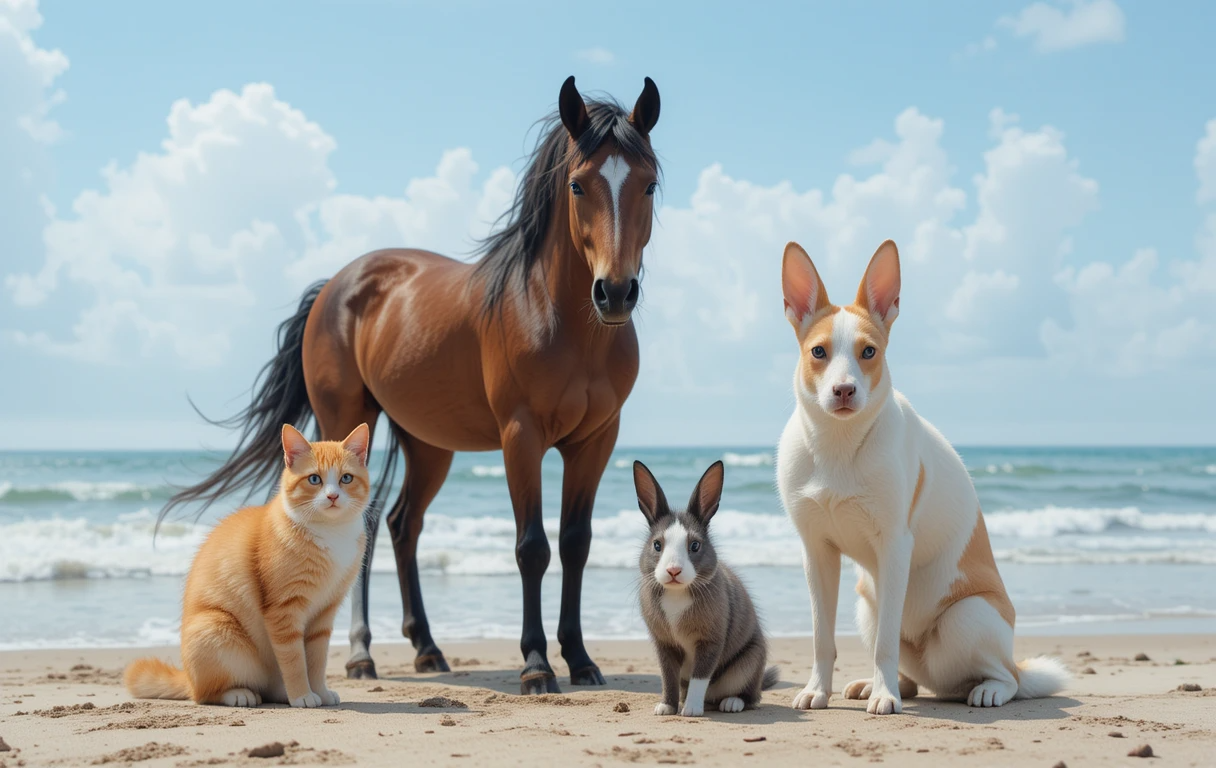
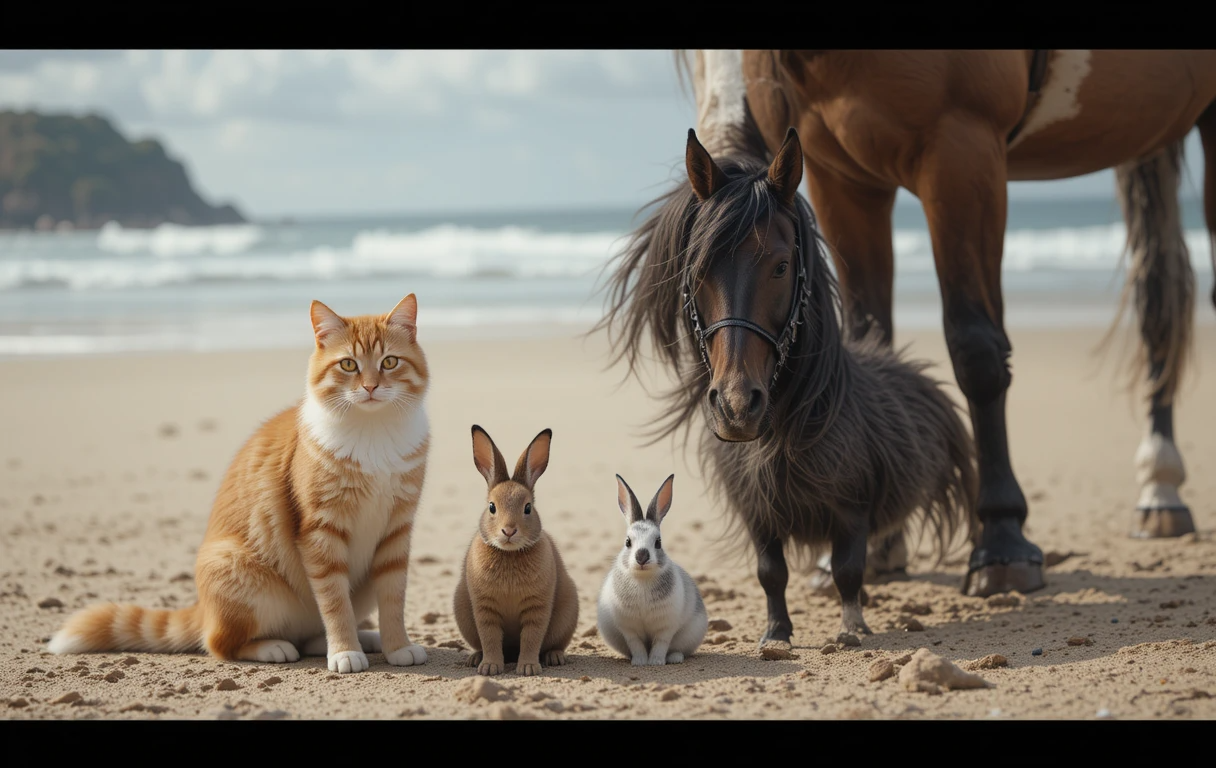
In the generated image, the 1~2 objects are missing.
This may indicate that the some token received insufficient attention in the text encoder, or was filtered out during cross-attention mechanisms in the U-Net.
🧪 Research Context
Recent studies highlight the competition between tokens and semantic bottlenecks in multi-object prompts:
- Text encoders bottleneck compositionality in contrastive vision-language models (ACL 2023)
- Words Worth a Thousand Pictures (ACL)
- Be Yourself: Bounded Attention for Multi-Subject T2I Generation (ECCV 2024)
- Interpreting Text Encoders in Text-to-Image Pipelines (ACL 2024)
These findings suggest that the problem runs deeper than prompt engineering—it's architectural.
Real-World Impact
This isn't just an academic curiosity. Multi-object generation failures impact:
- E-commerce: Product catalog generation with multiple items
- Advertising: Complex brand scenes with multiple elements
- Education: Multi-concept educational illustrations
- Content Creation: Detailed narrative visualizations
🧭 Coming Up Next
Part 2: "Unraveling Text Encoder Dynamics in Diffusion Models"
We'll dissect how attention evolves layer-by-layer and discover why certain object tokens like cat degrade or vanish as they pass through the CLIP text encoder.