A Comprehensive Guide to Object Detection: Techniques, Applications, and Future Trends

Object detection is one of the most critical tasks in computer vision, enabling machines to not only recognize objects within an image but also determine their location. This technology has broad applications in fields like autonomous driving, healthcare, security, and even retail. In this post, we’ll delve into the basics of object detection, its key techniques, applications, and the future trends shaping this field.
What is Object Detection?
Object detection is a computer vision technique that identifies objects in an image or video and marks their locations with bounding boxes. It goes beyond simple classification (which tells you what an image contains) by determining where in the image each object is located. The technology is integral to systems that need to understand and interact with the visual world, such as self-driving cars, video surveillance systems, and robotic systems.
At its core, object detection involves two main tasks:
- Object Classification: Identifying the object in an image (e.g., a car, person, dog, etc.).
- Object Localization: Determining where the object is in the image by drawing a bounding box around it.
Key Techniques in Object Detection
Over the years, several methods and algorithms have been developed for object detection, ranging from traditional methods to deep learning-based approaches. Let’s explore some of the most prominent ones.
1. Traditional Object Detection Methods
Before the deep learning revolution, traditional object detection methods relied on techniques like feature extraction and classifiers. These methods were less effective for complex images but laid the groundwork for modern techniques.
- Haar Cascades: One of the earlier methods, Haar cascades use edge or line detection features combined with a cascade of classifiers to detect objects. This technique was commonly used for tasks like face detection but is now outdated due to its limitations in real-world performance.
- Histogram of Oriented Gradients (HOG): HOG is another traditional feature extraction method that focuses on the gradient orientations of an image. Combined with a support vector machine (SVM) classifier, it has been used for detecting pedestrians in images. Although effective for specific use cases, it struggles with more complex object shapes and occlusions.
2. Deep Learning-Based Object Detection
With the rise of deep learning, object detection has made significant advances. Deep learning-based methods are far more accurate and efficient for real-world applications because they automatically learn to extract meaningful features from data.
a. R-CNN (Region-based Convolutional Neural Networks)
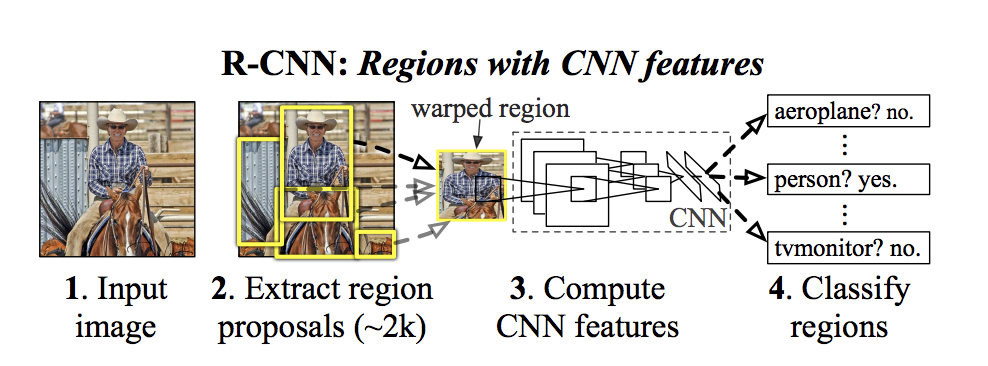
- Overview: The introduction of R-CNN was a major breakthrough in object detection. R-CNN first proposes regions of interest in the image (using techniques like selective search) and then applies convolutional neural networks (CNNs) to classify and refine the objects within those regions.
- Strengths: It brought significant accuracy improvements to object detection tasks.
- Limitations: R-CNN is slow and computationally expensive since it applies the CNN to each proposed region independently.
b. Fast R-CNN and Faster R-CNN
- Overview: Fast R-CNN improved on the original R-CNN by applying a single CNN to the entire image, making it faster. Faster R-CNN further improved efficiency by introducing a region proposal network (RPN) that quickly generates regions of interest.
- Strengths: Faster R-CNN became a popular choice for high-accuracy object detection, significantly speeding up the process while maintaining accuracy.
- Limitations: While much faster than R-CNN, it is still slower than some newer approaches, especially for real-time applications.
c. YOLO (You Only Look Once)
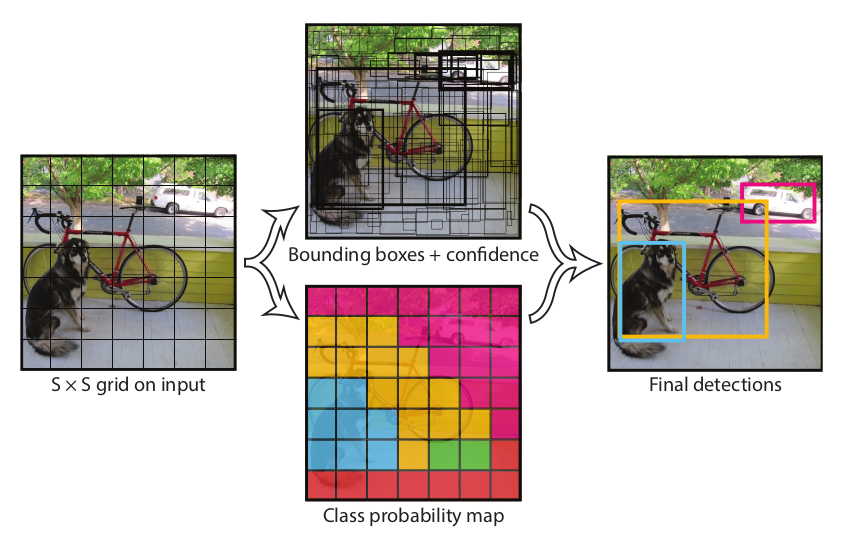
- Overview: YOLO is one of the most influential object detection models, designed for real-time applications. Unlike R-CNN-based methods that propose regions and then classify, YOLO views object detection as a single regression problem, predicting both bounding boxes and class probabilities in one pass through the network.
- Strengths: YOLO is extremely fast, capable of real-time detection without sacrificing too much accuracy. It is often used in autonomous systems, like drones and self-driving cars.
- Limitations: YOLO’s accuracy can sometimes fall behind in detecting smaller objects or objects that are close together.
d. SSD (Single Shot MultiBox Detector)
- Overview: SSD is another fast object detection algorithm, similar to YOLO, but with a different architecture. It predicts bounding boxes and class scores directly from the feature maps of the image without using a region proposal stage.
- Strengths: SSD is faster than Faster R-CNN and performs well with large objects. It is also more accurate than YOLO in detecting smaller objects.
- Limitations: While SSD is efficient, it is less accurate than Faster R-CNN for complex scenes where objects are close together or overlap.
e. EfficientDet
- Overview: EfficientDet is a newer model that improves both speed and accuracy. It is based on EfficientNet, a family of neural networks designed for scalability and efficiency. EfficientDet uses a weighted bi-directional feature pyramid network (BiFPN) to aggregate multi-scale features, making it more efficient than its predecessors.
- Strengths: It provides a good balance between speed and accuracy and is highly scalable for different detection tasks.
- Limitations: Although efficient, it may still require fine-tuning for specific use cases to achieve optimal performance.
Applications of Object Detection
Object detection has a wide range of applications across industries, transforming how machines interact with their surroundings. Here are some of the most notable use cases:
1. Autonomous Vehicles
Object detection is crucial in autonomous driving systems. Vehicles need to detect pedestrians, traffic signs, other cars, and obstacles in real time to navigate safely. Models like YOLO and Faster R-CNN are commonly used in these systems due to their balance of speed and accuracy.
2. Security and Surveillance
In video surveillance, object detection helps in recognizing suspicious behavior, detecting intruders, or identifying people and objects in crowded spaces. Deep learning-based models are used to analyze real-time video feeds for automated monitoring, reducing human error.
3. Healthcare
In the healthcare sector, object detection is used for medical imaging tasks, such as detecting tumors, lesions, or anomalies in X-rays, MRIs, or CT scans. These systems assist doctors in making more accurate diagnoses by highlighting areas of interest in medical images.
4. Retail and E-commerce
In retail, object detection is used in various applications, such as automated checkout systems, where cameras detect and recognize products in real time. It is also used for inventory management, enabling stores to track stock levels based on what is on the shelves.
5. Robotics
In robotics, object detection allows robots to perceive and interact with their environment. This is critical for tasks such as object manipulation, navigation, and interaction in dynamic, real-world settings. Robots in warehouses, for example, use object detection to identify packages, sort them, and move them to the correct locations.
Challenges in Object Detection
While object detection has made significant strides, there are still several challenges that need to be addressed:
1. Occlusion
Occlusion occurs when one object overlaps with another, making it harder for the model to detect each object separately. This is a common challenge in crowded scenes or complex environments, where objects partially or fully obscure each other.
2. Small Object Detection
Detecting small objects in large images remains a difficult task for many object detection models. Models like YOLO and SSD tend to struggle with small objects, often missing them or inaccurately predicting their bounding boxes.
3. Real-Time Processing
Although models like YOLO and SSD are designed for real-time processing, the demand for faster and more accurate object detection continues to grow, especially in industries like autonomous vehicles or robotics, where every millisecond counts.
4. Data Bias and Generalization
Object detection models are often trained on large datasets, which may introduce biases. These biases can result in poor performance when the model encounters objects in new environments or under different lighting conditions, leading to poor generalization.
Future Trends in Object Detection
As object detection continues to evolve, several key trends are shaping the future of this field:
1. Integration with Edge Computing
The rise of edge computing is enabling object detection models to be deployed directly on edge devices, such as smartphones, drones, or autonomous vehicles, rather than relying on cloud-based systems. This reduces latency and allows for faster decision-making in real-time applications.
2. Multi-Modal Learning
Object detection is increasingly being combined with other AI techniques, such as natural language processing (NLP), to develop more comprehensive systems. For example, a system could use NLP to understand spoken commands while using object detection to visually interpret and respond to those commands.
3. Self-Supervised Learning
In the future, self-supervised learning may play a significant role in reducing the need for large, labeled datasets. This technique allows models to learn from unlabeled data, potentially improving object detection accuracy in real-world environments where labeled data is scarce.
Conclusion
Object detection has become a critical tool in enabling machines to interact with the world in a meaningful way. From the traditional methods like Haar cascades to deep learning-powered models like YOLO and Faster R-CNN, the technology has come a long way. Its applications across industries—ranging from autonomous vehicles to healthcare—demonstrate its versatility and importance.
Request a Demo and Test It Yourself
If you're interested in trying these Stable Diffusion versions yourself, you can request a test demo link! When you subscribe, we will send you a unique demo URL that’s valid for 12 hours within 24 hours of your request. This will allow you to explore the capabilities of each version and see how they handle different prompts and styles.
Simply subscribe, and your demo link will be on its way!